
Guidance on documentation
Descriptions of documents needed for licence and rating applications and how to send them to us in the right format.
All personnel licensing applications require supporting documents to be submitted as part of the application process. Where photocopies are being provided in lieu of original documents, some will need to be certified.
A certified copy is a copy of a document which is signed by an authorised person who has seen the original document and can vouch that the copy has been made accurately and honestly. Photocopies of documents that have been sent by email cannot be certified as true copies as the certifier has not compared it to the original document.
Certification requirements vary depending on the type of document that is being provided.
You need to provide a copy of your Flight Crew licence for all pilot licensing applications. This can be a photocopy or a photograph of your licence, as long as the photo is of a high enough resolution that it can be zoomed into and all text can be clearly read.
Unless the photo is of high enough quality (sufficiently sharp and not blurry), we will be unable to accept it and will therefore request a better copy, which will delay your application.
These copies do not need to be certified.
If you are applying for any pilot licence under the Military Aircrew Accreditation Scheme (MAAS) based on your service as a pilot in the UK military, you will need to provide the following documents alongside those required for the licence application:
- completed form SRG 2133
- copies of the following logbook pages:
- the Special Qualifications page
- the last few pages of your military flying logbook
The copies of the logbook pages must be stamped and certified by either
- your commanding officer or
- the head of training at the ATO where any additional training for your application has taken place
If you are claiming credits based on your military instrument rating you will be required to provide a certified copy of the IR qualification page in your military log book. You will also need to provide a certified copy of any page that shows when you last exercised instrument rating privileges.
Qualified flight instructors
If you are claiming credits as a military qualified flight instructor (QFI) provide certified logbook evidence of your QFI qualification.
If you provide evidence that the experience requirements of FCL.910.Fl(c) have been met previously using the instructor privileges on your military qualifications the Part-FCL instructor certificate can be issued without the privileges restricted.
If you are applying for a FI(A) certificate and hold a night or aerobatic rating on your Part-FCL licence the instruction privilege can be added to their flight instructor rating by:
- demonstrating the ability to instruct for that rating during the assessment of competence
or - if you do not meet this requirement at issue of the FI rating, you must meet the relevant requirements of Part-FCL
The UK CAA are no longer issuing LAPL(A) licences. Students that have trained for the LAPL(A) but did not have their licence issued prior to 1st October 2025, need to apply for an NPPL. Follow the guidance on the NPPL webpage.
What to send if your application is based on you holding an ICAO compliant licence from a non-EASA state.
If you are applying for any licence or rating on the basis of an ICAO-compliant licence held from a non-EASA state (a 'third-country' licence), you will need to include the following documents along with the other documents required for your application:
- a certified copy of your current and valid third country ICAO licence and validating medical certificate.
- documentation showing that you have met the flying experience requirements for the licence or rating you are applying for and that you are in current flying practice: ie your original flying logbook(s) or certified copies.
- Third Country Verification application form SRG2142 (to enable us to verify your licensing details with the other authority)
Electronic logbooks are acceptable for all types of application provided they have been printed, signed and dated.
If your ICAO licence does not show the validity dates of the ratings, submit certified copies of logbook pages showing the rating validity and test dates.
You will be asked to submit proof of ID with certain licensing applications.
For customers using PDF application forms, there are two ways to provide proof of ID:
- by providing a photograph of you holding your photo ID
- by providing a certified copy of your photo ID
Providing a photograph of you holding your photo ID
The option to provide a photo of yourself holding your ID is provided as an alternative to obtaining a certified copy.
How to take the photo:
- take the photo in a room with enough light
- select the highest photo quality on the device you are using to take the photo
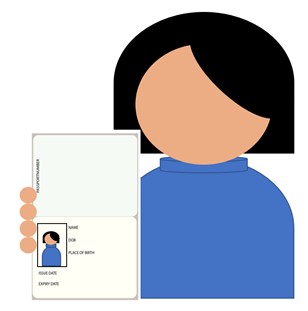
- hold up your ID document next to your face
- make sure both your head and shoulders are visible in the picture
- make sure your ID is clear in the photo. Nothing on the ID can be covered. The picture on your ID must be clear and all text must be legible
If your photo is not of high enough quality (sufficiently sharp and not blurry), we won’t be able to accept it and will therefore request a better or certified copy, which will delay your application.
We are unable to accept a photo where the passport image is reversed. Ensure your ID document is the right way around so it is readable, before submitting your photo.
Example
Providing a certified copy of your photo ID
Alternatively, you can provide a photocopy of your photo ID that has been certified by someone working in a 'recognised profession'.
Certification format
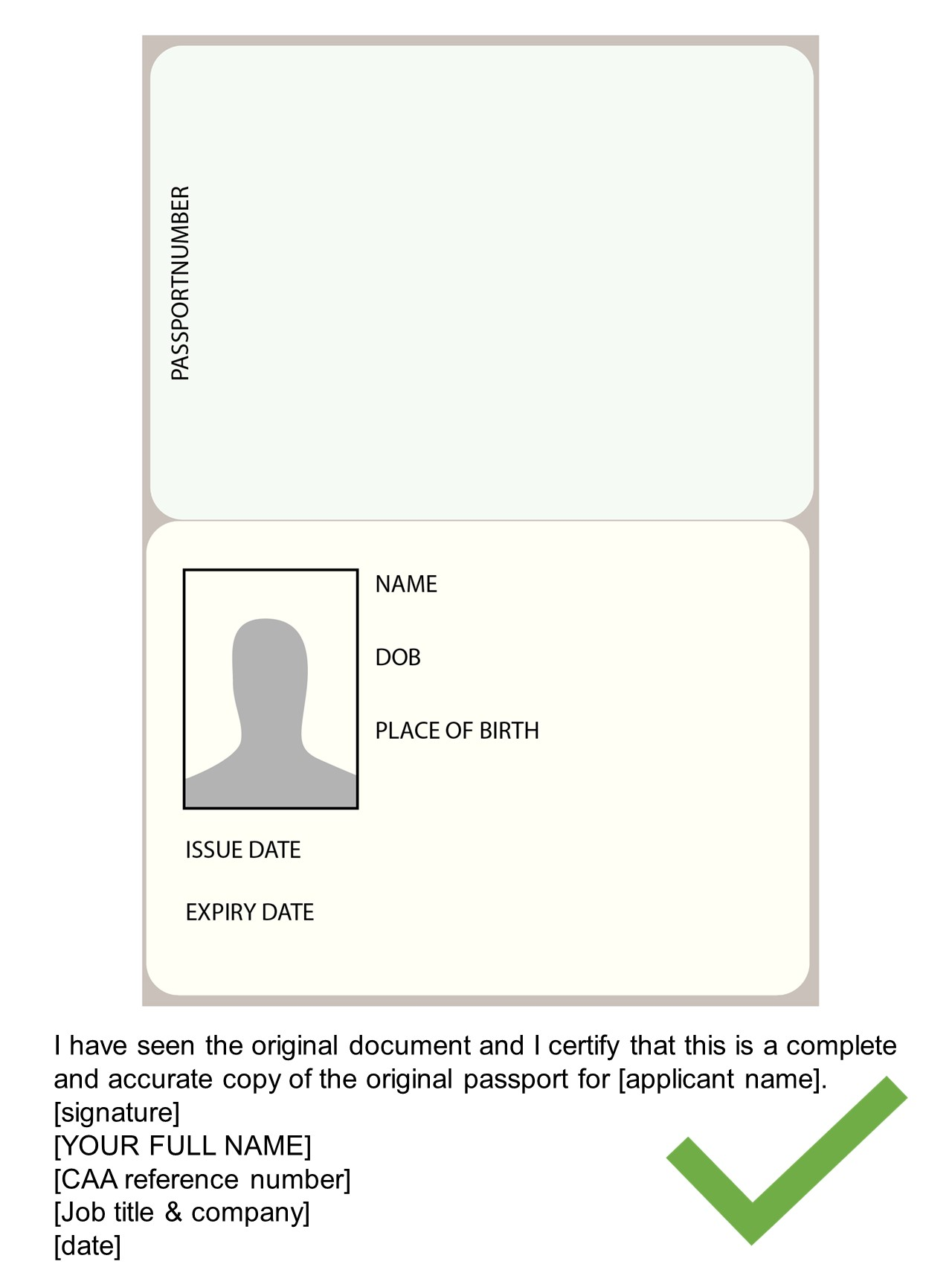
The certifier should write the following on each copy:
- the declaration “I have seen the original document and I certify that this is a complete and accurate copy of the original passport/driving licence for (applicant name)”
- their signature
- their name (in block capitals)
- their position/job title (for example, "Head of Training at [company name]")
- their CAA reference number (where applicable) or their professional qualification number
- the date
It does not matter where on the page the certifier enters the certification text, as long as they don’t write over the photo or passport/driving licence details.
Example
If you need to change the name on your licence, we may ask for a certified copy of your marriage certificate or deed poll certificate to be submitted with your change of details application.
Who can certify your marriage certificate or a deed poll
Your certificate can be certified by someone working in a 'recognised profession'.
Certification format
The certifier should write the following on each copy:
- the declaration “I have seen the original document and I certify that this is a complete and accurate copy of the original [marriage certificate] for [applicant name]”
- their signature
- their name (in block capitals)
- their position/job title and company(for example, "Head of Training at [Company name]")
- their CAA reference number (where applicable) or their professional qualification number
- the date
Guidance on submitting copies of your logbooks.
You will be required to submit your flying logbook(s) in support of certain pilot licensing applications. Where this is necessary, you may choose to submit your original logbook(s) or a copy.
Our staff are unable to advise you on how many logbook pages to submit. You will need to submit sufficient logbook evidence to cover the requirements of the licence/rating you are applying for.
The CAA retains the right to request a pilot’s original logbook at any time.
Paper logbooks
If you have a paper logbook, you should provide a scan or photocopy of all of the relevant pages.
Ensure you include a copy of the 'personal details' page of your logbook to show who the logbook belongs to.
Copies of logbook(s) must clearly identify all the requisite experience requirements relevant to the licence or rating application submitted. You will need to submit sufficient logbook pages to cover all of the requirements of the licence/rating you are applying for.
If you are unable to submit copies, you can submit your original logbook(s) with a covering letter by post to:
Flight Crew Licensing, CAA
Aviation House, Beehive Ring Road,
Crawley,
West Sussex,
RH6 0YR
You must ensure that the 'Personal Details' page of your logbook has been fully completed. This is to ensure that the licensing department can determine with full certainty who the flying hours belong to. Logbooks received with a blank personal details section will be posted back to the sender, thus delaying their application.
Original logbooks can also be dropped off at our Gatwick office in person. If you choose to submit your logbooks in person, you will need to leave them with our licensing team, who will post them back to you with your new licence. The licensing team will not review your application or be able to answer queries whilst you are at our Gatwick office. For a document checking service, you will need to book an appointment.
Electronic logbooks
If you have an electronic logbook, you must download it and submit it to us as part of an application for a licence or rating.
The logbook should be electronically signed, to show who it belongs to. This may be a signature applied to your logbook in the application you use to store your flight logs, or it may be a digital signature applied to the file, in a programme such as Adobe, after you have downloaded your electronic logbook.
If the electronic logbook has a cover page/personal details page, this should be included in the file too.
Alternatively, copies of electronic logbooks can be printed and hand signed. Only one page of the logbook needs to be signed, but it must include the date, owner’s full name, signature, and CAA reference number. The signed copy can then be scanned and attached to your application.
If you are unable to submit copies, you can submit the printed copies by posting them with a covering letter to:
Flight Crew Licensing, CAA
Aviation House, Beehive Ring Road,
Crawley,
West Sussex,
RH6 0YR
Lost, damaged or stolen logbooks
The CAA no longer accepts the submission of a sworn affidavit as the primary means of accepting hours for a licensing service where an individual is unable to provide logbook evidence of their required hours due to loss, damage, theft or data corruption.
In order for the CAA to confirm the hours experience, a pilot will now have to attend an appointment where an appropriately qualified member of staff will determine how many hours experience can be verified. This verification would be constructed based on the evidence historically provided within pilot’s previous applications which are stored by the CAA, and any legitimate evidence provided by the applicant at the time of the interview.
Individuals in such a position will now be required to follow the process stated below:
- Notify the CAA in writing, by contacting fclweb@caa.co.ukstating the subject ‘LOST LOGBOOK’. The email must provide name, date of birth and CAA reference number (if issued), together with a brief account of the reason why the logbook is not in your possession. Reasons may, for example, include loss, theft, damage or, in the case of e-logbook records, corruption/deletion of data. Any loss, theft or malicious damage will be expected to have been reported to the police and evidence must be provided to that effect, including an incident reference number. You can then expect an email reply confirming what documentation you should bring along to your interview.
- Once you have gathered all the evidence you will have to call us on 0330 022 1922 and arrange a payment for this appointment. This meeting is charged £145 which is non-refundable. A member of our Technical team will then be in contact to confirm the date and time for your appointment.
- Attendance of the appointment. The CAA is unable to provide a timescale for the completion of this review, as this will be dependent upon the amount and complexity of the evidence provided by the applicant.
All applicants are reminded that it is an offence under the UK Air Navigation Order to make, with intent to deceive, any false representation for the purpose of procuring the grant, issue, renewal or variation of any certificate, licence, approval, permission or other document. This offence is punishable on summary conviction by a fine, and on conviction on indictment with an unlimited fine or imprisonment or both.
Training Providers, Instructors and Examiners need to be aware that the CAA will no longer accept a sworn affidavit as the primary means of accepting hours, so this needs to be taken into account prior to any recommendation for the grant of any privileges for a person without a logbook. However, where possible, they are requested to assist individuals who find themselves in this predicament by ensuring that any statements provided can be supported by their training logs, aircraft logs and personal logbooks.
In order to certify a document for a licensing application, the certifier must meet the following criteria:
The certifier must:
- be 18 or over
- work in (or be retired from) a ‘recognised profession’
The certifier cannot be someone:
- you’re related to by birth or marriage
- you’re in a relationship with or live with
The following are considered to be a ‘recognised profession’.
Aviation professionals:
- Airline Pilot - must hold a UK issued pilots’ licence
- Base Captain
- Chief Flying Instructor (CFI)
- Engineer - must hold a UK issued engineers’ licence
- Fleet Manager
- Head of Flight standards at an Air Operator Certificate holder or authorised signatory
- Head of Training at your Approved Training Organisation
- UK-approved examiner
Non-aviation professionals:
- Accountant
- bank or building society official
- Barrister/Solicitor
- commissioner for oaths
- Councillor, for example local or county
- civil servant (permanent)
- Dentist
- Doctor
- financial services intermediary, for example a Stockbroker or Insurance Broker
- fire service official
- justice of the peace
- local government officer
- Member of Parliament
- Minister of a recognised religion (including Christian Science)
- Nurse (RGN or RMN)
- Officer of the Armed Services
- Optician
- paralegal (certified paralegal, qualified paralegal or associate member of the Institute of Paralegals)
- Pharmacist
- Police Officer
- Post Office official
- Warrant Officers and Chief Petty Officers