
Pack right. Safe flight.
Pack safely to avoid delays or missing your flight.
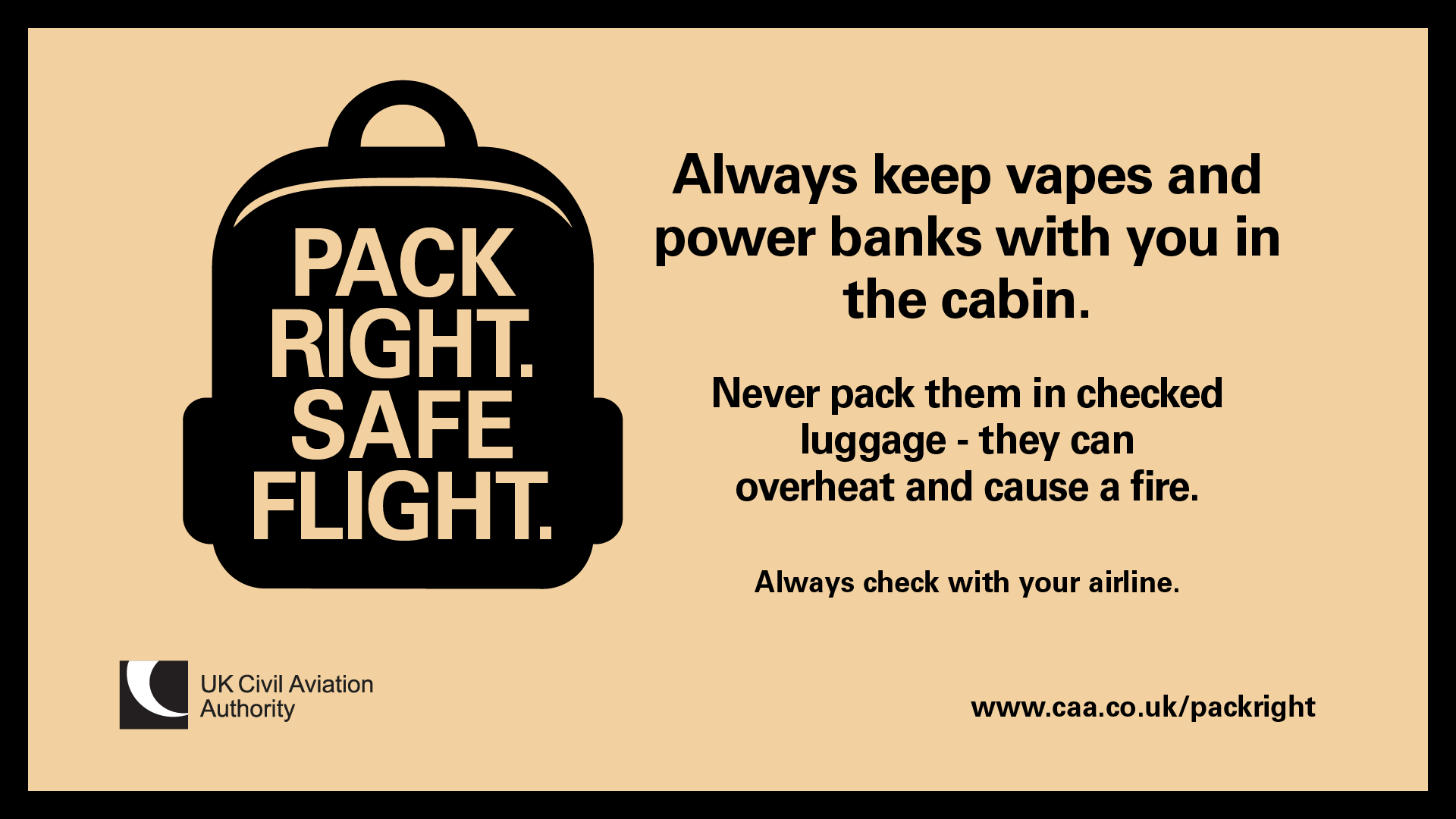
Always keep vapes and power banks with you in the cabin.
Never pack them in checked luggage — they can overheat and cause a fire.
Always check with your airline.
On this page: Checklist, Checked baggage, Carry-on, Packing tips, Safety tips when travelling with lithium batteries , What you need to know about battery sizes, Sending goods by air
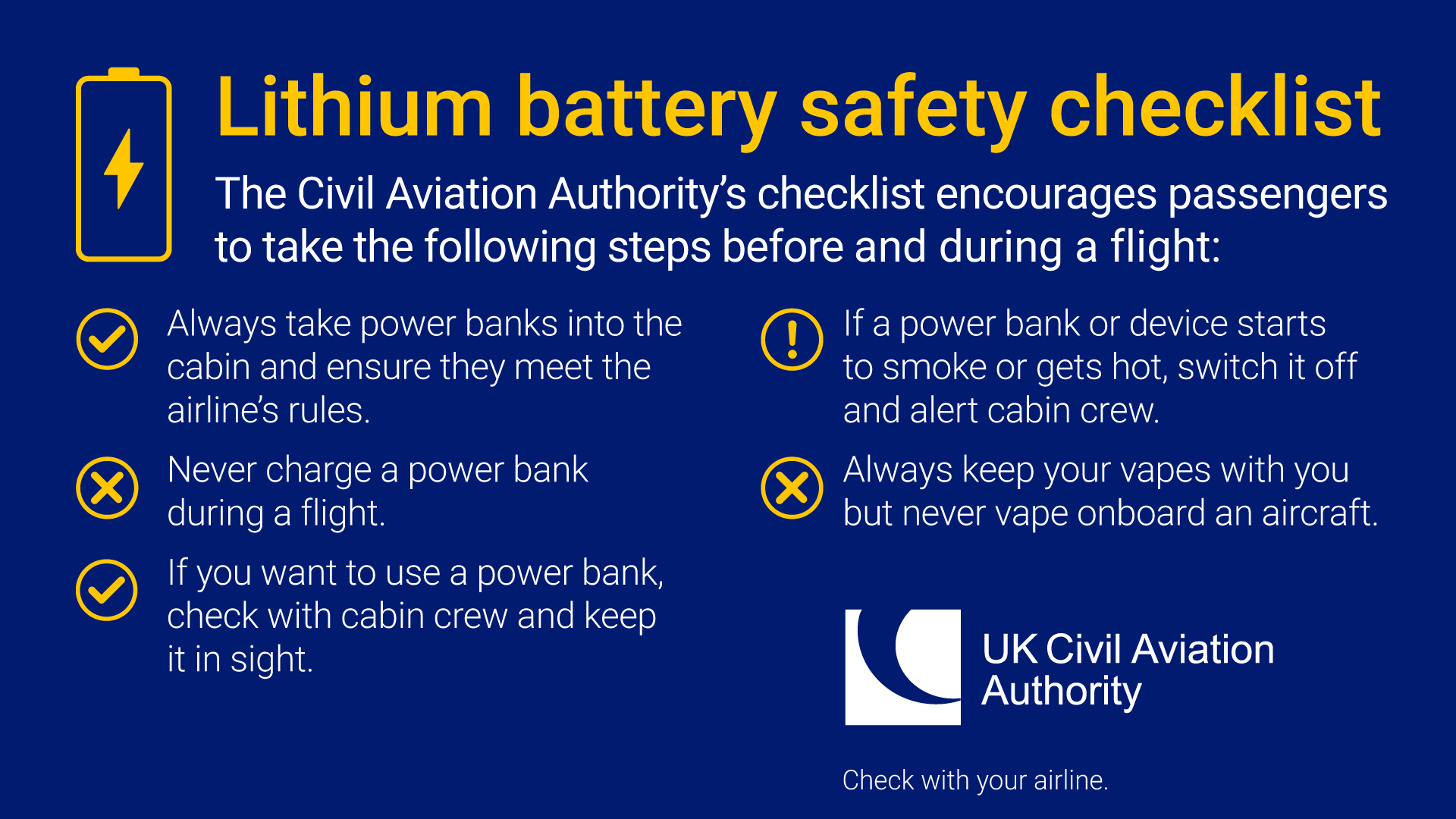
The Civil Aviation Authority’s checklist encourages passengers to take the following steps before and during a flight:
- Always take power banks in the cabin and check with your airline that they meet its size and quantity limits for carriage.
- Do not charge your power bank on any flight.
- If you want to use a power bank on a flight, first check that your airline allows it and keep it easily accessible.
- If a power bank, vape, phone or tablet starts to get hot then switch it off and stop charging and alert the cabin crew immediately.
- If a power bank or device starts to smoke, alert the cabin crew immediately. They are trained to deal with the issue safely.
- Always carry vapes inside the cabin with you but never vape onboard an aircraft.
Checked baggage
Checked baggage is luggage that you hand over to your airline at check-in to be stored in the aircraft’s cargo hold.
Carry-on
Carry-on, or hand luggage, is carried with you on board the aircraft. It includes bags, backpacks, handbags and items in your pockets.
Packing tips
Check your airline’s baggage rules and:
- always take spare batteries, vapes, e-cigarettes and power banks with you in the cabin.
- you can only take two power banks per person. These should never be re-charged onboard the aircraft. You may be asked to put power banks in your seat back pocket rather than in an overhead locker.
- phones, tablets and laptops should normally be taken with you in the cabin unless they are completely turned off and protected from damage.
- pack your own bags.
- check if any items are dangerous goods and where to pack them.
- don’t pack restricted or banned items.
- keep essential items (like medicine) in your carry-on.
- follow size and weight limits.
- inform your airline of any special needs before you travel.
- keep baggage with you—never leave it unattended.
Safety tips when travelling with lithium batteries
These simple steps help keep you and your fellow passengers safe:
- choose reputable suppliers and brands when buying devices and spare batteries.
- follow airline rules and manufacturer instructions for carrying and using lithium batteries.
- keep spare batteries with you in the cabin and protect them from damage.
- If before boarding your cabin bag is taken to be placed in the hold then remember to remove any batteries or lithium powered devices.
- you can take two power banks per person. These should never be recharged onboard the aircraft.
- Batteries that show signs of damage, overheating, or swelling should not be used and should never be carried on an aircraft.
What you need to know about battery sizes
If your airline has limits based on the power of your battery, then this information can help:
- Under 100Wh are common in phones, laptops, and cameras – it is recommended that you take these devices with you in the cabin.
- 100Wh to 160Wh are found in power tools and large power banks – you require airline approval to carry these.
- Over 160Wh are prohibited in passenger baggage – you must transport them separately as dangerous goods cargo.
- If you have a battery powered mobility aid, then check with your airline ahead of travel.
If your battery or power bank doesn’t have the Watt hour rating (Wh) on its outer case, use this formula to calculate its size:
- Voltage (V) × Amp hours (Ah) = Watt-hours (Wh)
For milliamp hours (mAh), divide the answer by 1000:
- (V × mAh) / 1000 = Wh
Sending goods by air
If you’re sending goods by air, you must:
- check if they are dangerous goods;
- confirm if they can be transported by air;
- arrange for them to be packed properly and declare them correctly.