
Step 2: Define the Top Event
Step 2 which describes the undesired system state.
The Top Event represents the point at which control of the hazard is lost or the hazard is released. It creates an unsafe state that could lead to one or more consequences if not managed.
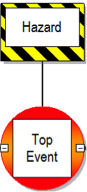
It is usually what we consider to be an unsafe state that is not yet an accident. Therefore, top events while not being disasters themselves have the potential to become one if nothing is done to control them.
In our driving a car on a busy motorway example, the top event could be described as losing control of the car.
Definition
A Top Event in a BowTie diagram, is the point in time which describes the release or loss of control over a Hazard.
Guiding principles
The Top Event represents the point at which control of a hazard is lost or the hazard is released, resulting in an undesired safety state. Positioned at the centre of the BowTie, the Top Event provides the link between the threats that could cause the loss of control and the potential consequences that may result from it.
By defining the Top Event, the BowTie enables the consideration of multiple threats and multiple potential consequences, rather than focusing on a single linear accident sequence.
If you find that the BowTie is not examining the area of risk that is of greatest interest, consider whether the Top Event has been defined at the appropriate point. Moving the Top Event further left or right may help to better focus the analysis and achieve the required level of detail.
Traps and tips
Trap: Rushing into, or persisting with, a hazard and top event definition that does not adequately address the area of risk being examined.
Tip: Remain flexible throughout the modelling process. It often takes several iterations to identify the most appropriate hazard and top event definitions. If the BowTie becomes overly complex or fails to provide the required insight, consider refining the scope or redefining the top event.
Trap: Attempting to capture multiple top events or complex risk pathways within a single BowTie can result in an overly large, confusing, and difficult-to-manage model.
Tip: Remember that a single hazard may be associated with multiple top events. Where appropriate, develop several manageable and logically structured BowTies rather than one overly complex model. Linked BowTies can provide a holistic view of the risk while maintaining clarity and usability.