
Introduction to bowtie
How this risk assessment tool works.
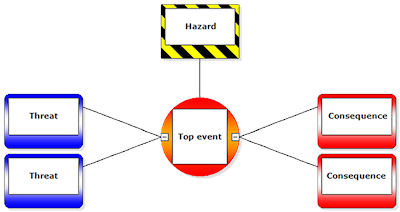
The BowTie model is a structured risk management methodology used to identify, visualise, and analyse risk. It links a hazard to the threats that could result in a loss of control, together with the preventive controls that reduce the likelihood of this occurring. The model also illustrates the potential consequences of a loss of control and the recovery controls that reduce the likelihood or impact of those consequences.
When building a BowTie, users should consider the following key components:
|
Hazard |
Top Event |
|
A condition, situation, activity, or object that could cause or contribute to an aircraft incident or accident. |
A Top Event in a BowTie diagram, is the point in time which describes the release or loss of control over a Hazard |
Once the hazard and top event have been identified, the direct threats and potential consequences can be considered.
|
Threats |
Consequences |
|
A possible direct cause for the top event |
A potential outcome or effect resulting from the release of the ‘top event,’ which directly results in harm (to people), loss, or damage |
Controls are measures put in place to manage risk by preventing unwanted events or reducing their impact.
Controls can be applied to either side of the BowTie model:
|
Left hand side of the model |
Right hand side of the model |
|
Preventive measures which eliminate the threat entirely or prevent the threat from causing the top event recovery |
Measures which reduce the likelihood of the consequence owing to the top event being "live" or mitigate the severity of the consequence. |
The BowTie model also considers escalation factors. These are conditions or circumstances that may reduce the effectiveness of a control or cause it to fail altogether.
Where escalation factors are identified, escalation factor controls can be introduced to prevent or minimise their impact on preventive or recovery controls.
Additional attributes, such as control effectiveness, assurance measures, and criticality, can also be incorporated into the model. These help organisations evaluate risk and support the effective operation of their Safety Management System (SMS).
Please see further guidance in the next chapter called “BowTie elements and evaluating a BowTie.