BowTie Risk Modelling Benefits
How risk is shown using the bowtie tool.
BowTie is a visual tool used to illustrate and understand risk. It helps identify the safety controls to preventing an undesirable event prevents a safety event from occurring, or mitigate its consequences should it occur, highlighting both existing controls and potential gaps.
There are many ways to develop a bowtie, and organisations should adopt an approach that best suits their needs. While the examples and guidance provided here are based on the use of BowTieXP software, the principles and terminology of bowtie analysis can be applied using a variety of tools, including Visio, Excel, facilitated workshops, and paper-based methods.
The value of bowtie analysis does not depend on specialist software. Its real strength is in supporting meaningful risk discussions, helping organisations understand their hazards, threats, consequences and controls, and identifying opportunities for improvement. Bowtie assessments can be undertaken using any approach that enables risks and controls to be clearly identified, understood, and communicated.
BowTie models are a key part of Performance-Based Regulation (PBR) and support:
- An enhanced visual representation of risk.
- A balanced, cross-domain view of risk across the aviation system, enabling a shared understanding between internal and external stakeholders, including consideration of third-party risks and exposure.
- An increased awareness and understanding of the safety risk leading to the CAA ‘Key Risk Areas’
- The comprehensive and wide-ranging practical guidance material for safety risk management at an operational and regulatory level.
- The identification of critical risk controls and the assessment of their effectiveness.
- An identification of SPIs to monitor performance of risk control.
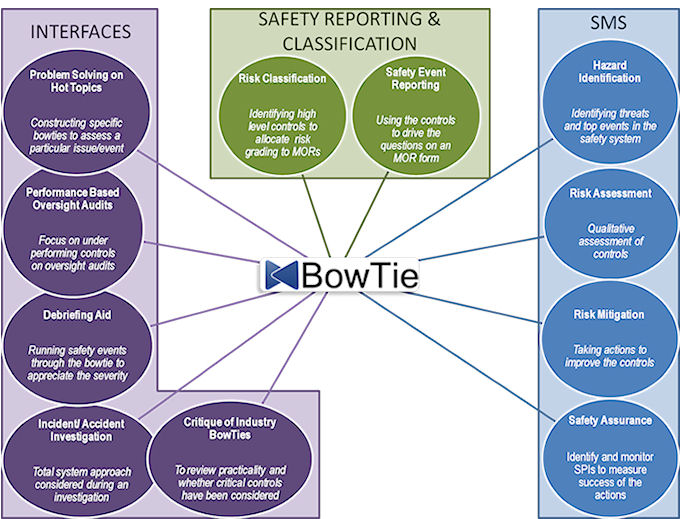
Bowties can also be used for a variety of tasks as shown below: (You can download this diagram as a PDF).