
UKADS and UKACS governance
Governance arrangements for NERL’s UKADS and UKACS by the Joint Airspace Modernisation Programme Board.
The Airspace Modernisation Strategy governance structure is key to delivering airspace modernisation successfully. It ensures that each of the organisations involved has the right role, powers and/or incentives, underpinned by appropriate governance and enforcement. It sets out which organisations make decisions, what they are responsible for, and the stakeholders they will engage with. The governance structure is Appendix A to CAP 1711: Airspace Modernisation Strategy 2023–2040 Part 1.
Because delivering the UKADS and UKACS are conditions of NERL’s air traffic service licence, ultimately NERL’s delivery of the UKADS and UKACS can be enforced via existing licence enforcement mechanisms. Day-to-day Department for Transport (DfT) and CAA governance of NERL’s UKADS and UKACS is achieved by including oversight of those services within the Airspace Modernisation Strategy governance structure.
In addition to the requirement in its licence regarding the appointment of a head of UKADS and UKACS, NERL should set up appropriate internal governance arrangements in accordance with relevant licence provisions and best practice in order to meet its obligations. NERL should ensure that it can demonstrate clear accountability to the DfT and CAA, including appropriate measures for performance management. There will need to be regular, transparent progress reporting by NERL to give the DfT and CAA assurance of progress.
The aim of these governance arrangements is to provide the necessary visibility and oversight for the DfT and CAA to hold the NATS Board to account for delivering the UKADS and UKACS in accordance with the NERL air traffic services licence and the Secretary of State’s strategic objectives for the UKADS and UKACS, within the wider Airspace Modernisation Strategy governance structure and ultimately the licence enforcement mechanisms.
The aim is for NERL’s provision of the UKADS and UKACS to be (and to be seen to be) transparent and effective in progressing its strategic delivery plan in the best interests of the UK airspace network, without conflicts of interest, in a non-discriminatory manner.
The Secretary of State has set strategic objectives for provision of the UKADS and UKACS, and NERL will submit to the DfT and CAA for approval the complete strategic delivery plan and any updates to it, such approval being limited to the form, scope and level of detail of the plan. The governance structure gives NERL full responsibility for day-to-day decision-making in providing the UKADS and UKACS. Involvement from the DfT or CAA is confined to strategic oversight of NERL’s delivery, a point of escalation from the Advisory Board for matters relating to clarification of government policy or CAA processes and guidance, and our respective decision-making roles on airspace change proposals. (The key decisions on whether an airspace change proceeds through different stages of the airspace change process will continue to be taken by the CAA, or by the Secretary of State for Transport if a proposal is 'called in'.)
DfT/CAA Joint Airspace Modernisation Programme Board
The wider airspace modernisation programme is governed through a regular DfT/CAA Joint Airspace Modernisation Programme Board, also attended by the Ministry of Defence. This is the forum for the DfT and CAA to manage the oversight of and reporting by NERL in relation to its delivery of the UKADS and UKACS, on behalf of Ministers and the CAA Board respectively.
The Joint Airspace Modernisation Programme Board considers issues that have been escalated to it by the Advisory Board (see Chapter 4 of the CAA’s guidance, CAP 3219) or where NERL wishes to seek guidance from the DfT and CAA. The Programme Board does not consider the specifics of any airspace change proposal. The Head(s) of the UKADS and UKACS will be invited to attend for the relevant agenda items, but they will not be members of the Joint Airspace Modernisation Programme Board. The Chair of the Advisory Board may also be invited by the CAA and DfT to the Joint Airspace Modernisation Programme Board for relevant agenda items.
Management information on NERL’s progress of its UKADS and UKACS (see below) forms part of the Joint Airspace Modernisation Programme Board's regular reporting, coordinated by the CAA’s airspace modernisation oversight team.
Oversight meetings
In addition to the Joint Airspace Modernisation Programme Board, at a working level, existing, regular oversight meetings between NERL, the DfT and CAA that monitor delivery of specific delivery elements of the AMS also monitor NERL’s ongoing UKADS and UKACS performance.
These meetings will be supported by appropriate information (including information specifically requested by the DfT and CAA in accordance with the terms of NERL’s licence), such as timelines, milestones, risk logs and resource plans. This information feeds into regular reporting to the Joint Airspace Modernisation Programme Board and annually into the Airspace Modernisation Strategy progress reports by the CAA to the Secretary of State.
UKADS and UKACS positioning in the Airspace Modernisation Strategy governance structure
The diagram summarises the governance of NERL as UKADS and UKACS provider by the Advisory Board and by the DfT and CAA via the Airspace Modernisation Strategy governance structure (and ultimately the licence enforcement mechanisms).
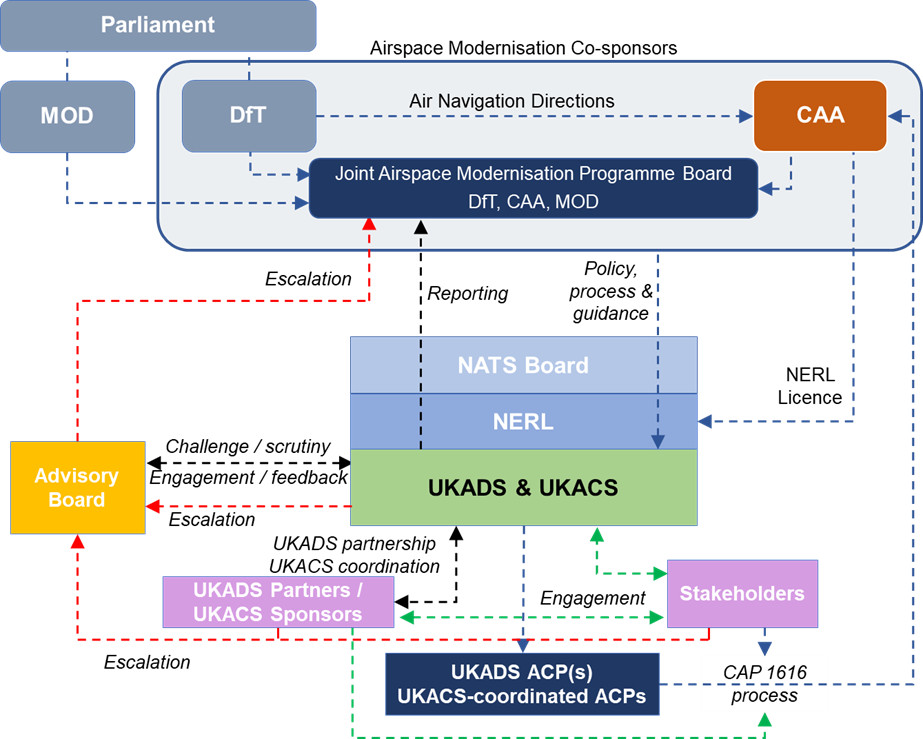
Key
- ACP = airspace change proposal
- Blue arrows = Policy, process or direction
- Green arrows = engagement
- Black arrows = information flow
- Red arrows = escalation route
Notes to the diagram
- The diagram shows the organisational structure of the governance arrangements for NERL’s provision of the UKADS and UKACS.
- At the top, DfT and MoD (overseen by Parliament) and the CAA are members of the DfT/CAA Co-sponsors Joint Airspace Modernisation Programme Board. DfT gives Air Navigation Directions and Air Navigation Guidance to the CAA.
- Below this, two blue boxes labelled NATS Board and NERL are stacked with a green box labelled UKADS and UKACS. The UKADS and UKACS provide reporting (upwards arrow) to the Joint Airspace Modernisation Programme Board which in turn provides them with guidance on policy and process (downwards arrow).
- The CAA issues NERL with an air traffic services licence, which contains the obligation for NERL to provide UKADS and UKACS and can ultimately be enforced by licence enforcement mechanisms, represented by an arrow from the Joint Airspace Modernisation Programme Board to NERL via its air traffic services licence.
- An orange box labelled Advisory Board is linked by a two-way arrow with the UKADS and UKACS box. The Advisory Board provides advice to NERL regarding its delivery of the UKADS and UKACS while exchanging views, ideas and information. An arrow marked Escalation goes from the Advisory Board to the Joint Programme Board.
- Two purple boxes sit underneath the UKADS and UKACS box. One is labelled UKADS partners and UKACS sponsors, which is connected by arrows to the UKADS and UKACS box, the arrows being labelled UKADS partnership and UKACS coordination. The second purple box is labelled Stakeholders and is connected by two-way engagement to the UKADS and UKACS box and to the UKADS partners and UKACS sponsors box. There is also an escalation arrow from both purple boxes to the Advisory Board box.
- At the bottom of the organogram is a dark blue box labelled UKADS ACP(s) and UKACS-coordinated ACPs, to which an arrow runs from the UKADS & UKACS green box above.
- Arrows labelled CAP 1616 process run from both purple boxes and the dark blue box to the CAA at the top of the organogram.
The perception by stakeholders of the success of UKADS and UKACS relies in part on transparency of information relating to their various activities. This should include a process for transparent and regular reporting between NERL and the DfT and CAA.
Regular reporting is used to hold NERL to account for the performance and delivery of the UKADS and the UKACS; to monitor non-discrimination; and to inform future policy development, including any potential amendment to the Secretary of State’s strategic objectives for NERL’s delivery of the UKADS and UKACS (such as any broadening of the scope of the UKADS in the future). Notwithstanding NERL’s licence condition to provide any information relevant to its provision of the UKADS and UKACS, we envisage that this reporting would use data that NERL is already collecting and using for its own purposes.
The detail of reporting, including any key performance indicators, will be determined by the DfT and CAA in discussion with NERL through the working-level arrangements mentioned above.
Reporting should include:
- the strategic delivery plan and the stakeholder engagement plan, and any updates to those plans
- progress in delivering the airspace change proposal(s) that the UKADS has been tasked with or that the UKACS has been tasked with coordinating against the priorities and key milestones in the relevant strategic delivery plan, including key stakeholders’ ability and appetite to deliver
- early visibility of any barriers to delivery or other emerging risks, challenges or issues, including whether the UKADS and UKACS have sufficient resources and capabilities to deliver the plan, issues with funding, technology, process or new policy and proposed mitigations and solutions
- issues where escalation to the Joint Airspace Modernisation Programme Board may assist with NERL’s delivery of UKADS and UKACS
- any dependencies for delivery, including interdependencies with other elements of the Airspace Modernisation Strategy, whether or not NERL is responsible for the programmes concerned
- anticipated and realised benefits from the UKADS and UKACS deliverables linked to the strategic objectives of the Airspace Modernisation Strategy, identifying the beneficiary stakeholder(s)
- information to support effective and informed engagement between the UKADS and the CAA, DfT or other stakeholders
- information about organisational changes within NERL affecting the UKADS or UKACS
- information to fulfil any statutory or parliamentary reporting requirements, including for example select committee inquiries, parliamentary questions and the CAA's annual Airspace Modernisation Strategy progress report to the Secretary of State
- information in support of regulatory interventions that might be required (for example, the use of powers under the Air Traffic Management and Unmanned Aircraft Act 2021).
In addition, the DfT and CAA may commission reviews or other information to provide them with assurance in relation to NERL’s provision of the UKADS and UKACS. The DfT and CAA will discuss the terms of such reviews with NERL on a case-by-case basis.