
This is an overview of some the international and domestic bodies that oversee environmental protection in relation to civil aviation and aerospace in the UK. It is not an exhaustive overview and should not be taken as the only bodies that oversee environmental protection of the aviation sector.
International Civil Aviation Organisation
Formed in 1947, the International Civil Aviation Organisation (ICAO) is a United Nations (UN) agency established to help Member States work together to achieve the highest possible degree of uniformity in civil aviation regulations, standards, procedures and organisation. The formation of ICAO followed the Convention on International Civil Aviation, commonly known as the Chicago Convention, which was drafted by 54 nations in 1944 and established the core principles permitting international transport by air. Today, the Chicago Convention has evolved to include more than 12,000 international Standards and Recommended Practices (SARPs), each of which have been agreed on a consensus-basis by the 193 ICAO Member States.
Annex 16 to the Convention on International Civil Aviation outlines the SARPs related to environmental protection. As a Member State of ICAO, the UK has agreed to collaborate with other Member States to improve the level of environmental protection in relation to these SARPs. There are currently four volumes to Annex 16:
- Volume I – Aircraft Noise;
- Volume II – Aircraft Engine Emissions;
- Volume III – Aeroplane CO2 emissions; and
- Volume IV – Carbon Offsetting and Reduction Scheme for International Aviation (CORSIA).
ICAO adopted a Long Term Global Aspirational Goal (LTAG) with respect to CO2 emissions, and has prioritised its environmental protection resources on:
- Airframe, propulsion, and other aeronautical and technological innovations;
- Optimising flight procedures to reduce fuel burn; and
- Increasing the production and deployment of sustainable aviation fuels and clean energy.
Committee on Aviation Environmental Protection
The UK is a founding member of ICAO’s Committee on Aviation Environmental Protection (CAEP). CAEP, a technical committee of the ICAO Council established in 1983, assists the ICAO Council in developing new policies and SARPs in relation to aviation noise, emissions and other environmental impacts. The ICAO Council subsequently reviews and adopts CAEP recommendations, including amendments to the SARPs, and in turn reports directly to the ICAO Assembly where the main policies on environmental protection are defined. The UK is represented in ICAO and CAEP by the Department for Transport (DfT), while the CAA and other specialists are nominated by the UK to CAEP’s technical working groups.
European Civil Aviation Conference
The UK is a Member State of the European Civil Aviation Conference (ECAC). Founded in 1955 as an intergovernmental organisation, ECAC seeks to harmonise civil aviation policies and practices amongst its 44 Member States and, at the same time, promote understanding on policy matters between its Member States and other parts of the world.
ECAC coordinates European activities with regard to aviation environmental protection, supporting the development of environmental guidance to improve efficiency in the use of resources among Member States, and to address the need for capacity building.
UK Government
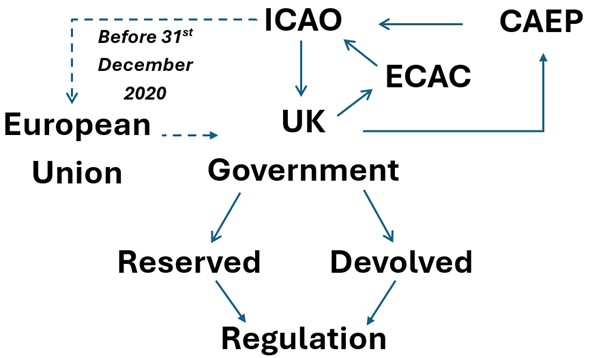
The UK Government operates through various departments and agencies which are responsible for putting Government policy into practice. While some departments have powers to create policy for the entirety of the UK, others cover only certain areas due to devolution, where powers are transferred to the devolved governments of Scotland, Wales, and Northern Ireland. Matters not devolved remain under the UK Parliament and are referred to as ‘reserved’ or ‘excepted’ matters.
UK aviation policy, including policies which relate to aviation’s impact on the environment, is primarily managed by the Department for Transport (DfT), although other Government departments also oversee environmental matters that relate to aviation. These include the Department for Environment, Food and Rural Affairs (DEFRA), the Department for Energy Security and Net Zero (DESNZ), and the Environment Agency.
Devolved Administrations
Devolution refers to the transfer of certain legislative and administrative powers from the UK Parliament to the devolved governments of Scotland, Wales, and Northern Ireland. Each devolved government is responsible for many domestic policy areas, and their respective Parliaments / Assemblies have varying degrees of authority with regard to law-making in this respect.
The domestic policy areas the Scottish Government, Welsh Government, and the Northern Ireland Executive are responsible for include:
- Health
- Education
- Culture
- Environment; and
- Transport.
UK Civil Aviation Authority
The UK Civil Aviation Authority (CAA), established by Parliament in 1972, is the UK’s independent aviation regulator and works to ensure that:
- the aviation industry meets the highest safety standards;
- consumers have choice, value for money, are protected and treated fairly when they fly;
- through efficient use of airspace, the environmental impacts of aviation on local communities are effectively managed and CO2 emissions are reduced; and
- the aviation industry manages security risks effectively.
The CAA is considered an Arm's Length Body (ALB) of the Department for Transport (DfT), it’s sponsoring Governent department. This means that whilst the DfT is responsible for the CAA’s general oversight and policy, it does not have direct control over the CAA’s day-to-day operations or management. The CAA acts within the legal powers given to it by legislation and the UK Government requires that its costs are met from charges to those it provides a service to or regulates.
In 2021 the CAA also became the UK’s space regulator, giving it the authority to license space companies under the Space Industry Act 2018 and the Outer Space Act 1989.