

As an International Civil Aviation Organisation (ICAO) Member State, the UK has agreed to collaborate with other Member States to improve the level of environmental protection across a number of areas, including aircraft emissions and air quality.
Volume II of Annex 16 to the Convention on International Civil Aviation contains Standards and Recommended Practices (SARPs) for aircraft engine emissions. These ICAO SARPs are only applied to subsonic and supersonic aircraft turbojet and turbofan engines with a thrust greater than or equal to 26.7 kilonewtons (kN). With the exception of Smoke Number, these standards do not apply to smaller turbofan and turbojet engines (with a thrust less than 26.7 kN), turboprop, turboshaft, piston engines, auxiliary power units and general aviation aircraft engines due to the large number of models, the economic cost of compliance, and small fuel usage compared to commercial jet aircraft. See ICAO Doc 9889 for further information.
ICAO Landing and Take-off Cycle
Engines intended for propulsion at subsonic speeds, where applicable, are certified under test conditions uninstalled from the aircraft. The emissions are measured against an idealised landing and take-off (LTO) cycle which account for aircraft from the ground up to 3,000 feet above ground level. This is known as the International Civil Aviation Organisation (ICAO) Reference LTO Cycle. The time in each operating mode of the ICAO Reference LTO Cycle, and applicable rated engine thrust settings are displayed below.
|
LTO operating mode |
Time in operating mode (minutes) |
Thrust setting (% of Maximum) |
|
Take-off |
0.7 |
100% |
|
Climb |
2.2 |
85% |
|
Approach |
4.0 |
30% |
|
Taxi/ground idle |
26.0 |
7% |
Table 4.1: ICAO Reference LTO Cycle
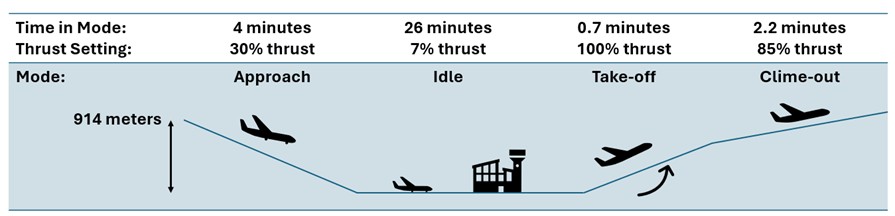
The engine thrust setting applied to each LTO operating mode is a percentage of maximum rated take-off thrust approved for use under normal operating conditions, without the use of water injection.
Emissions Certification: Subsonic Engines
Part III, Volume II of Annex 16 to the Convention on International Civil Aviation outlines the certification standards for several pollutants, and the ICAO Aircraft Engine Emissions Databank hosted by the European Union Aviation Safety Agency, contains data for all certified engines for which manufacturers have made data available. The databank outlines each engine’s compliance against the various emissions standards for the following pollutants:
Gaseous Emissions
Carbon Monoxide
Carbon Monoxide (CO) is a colourless, odourless gas formed during incomplete combustion of heating and motor fuels. It acts as a respiratory poison in humans and warm-blooded animals.
The CO standard applies to engines that have a rated thrust greater than 26.7 kilonewtons (kN) which are manufactured on or after 1 January 1986.
Hydrocarbons
Hydrocarbons (HC) are a compound made entirely of carbon and hydrogen.
The HC standard applies to engines that have a rated thrust greater than 26.7 kN which are manufactured on or after 1 January 1986.
Nitrogen Oxides
Nitrogen oxides (NOx) is a general term for both nitrogen dioxide (NO2) and nitric oxide (NO). They are gases which are formed mainly from the combustion of fossil fuels. NO is the dominant portion of these gases however it oxidises rapidly to form NO2 which is harmful to health. As this reaction takes place quickly and is reversible, NOx is used to refer to both gases.
The stringency of the NOx standards have increased over time via recommendations to the ICAO Council from the Committee on Aviation Environmental Protection (CAEP). The latest standards were informed by the 8th CAEP meeting in 2010 (CAEP/8).
Unlike HC and CO, there are more stringent NOx standards for new type engine designs and less stringent NOx standards for in-production engines that vary depending on when an engine was manufactured. For further information regarding the various NOx standards see Part III, Volume II of Annex 16 to the Convention on International Civil Aviation.
Non-Gaseous Emissions
Smoke Number
Smoke refers to the carbonaceous materials in exhaust emissions which obscure the transmission of light. The production of smoke usually occurs from unburnt, or partially burnt fuel.
The smoke number applies to engines with a date of manufacture which is on or after 1 January 1983 and before 1 January 2023. In addition, the standard applies to engines with a date of manufacture on or after 1 January 2023 that have a maximum rated thrust less than or equal to 26.7 kN. The smoke number has been superseded by the non-volatile particulate matter (nvPM) standard for engines with a rated thrust greater than 26.7 kN and date of manufacture after 1 January 2023.
Non-volatile particulate matter
Non-volatile particulate matter (nvPM) are particles that exist at the gas turbine engine exhaust nozzle exit plane that do not volatilise when heated to a temperature of 350°C. nvPM consists mainly of black carbon.
The Standards for nvPM apply to new type and in-production engines from 1 January 2020 and apply to those engines with a rated thrust greater than 26.7 kN. The nvPM standard replaces the smoke number for engines manufactured after 1 January 2023. For further information see Part III, Volume II of Annex 16 to the Convention on International Civil Aviation.
Intentional Fuel Venting
Part II, Volume II of Annex 16 to the Convention on International Civil Aviation states that all turbine engine powered aircraft intended for operation in international air navigation manufactured after 18 February 1982 shall be designed and constructed as to prevent the intentional discharge into the atmosphere of liquid fuel from the fuel nozzle manifolds resulting from the process of engine shutdown following normal flight or ground operations.
Emissions Certification: Supersonic Engines
Turbojet and turbofan engines intended for propulsion at supersonic speeds which were manufactured on or after 18 February 1982 are required to comply with the applicable standards for the following pollutants:
- Smoke Number
- Hydrocarbons;
- Carbon Monoxide; and
- Nitrogen Oxides
Further information regarding the certification standards for supersonic engines is available in Part III, Volume II of Annex 16 to the Convention on International Civil Aviation.