
Using class marks to work out where you can fly
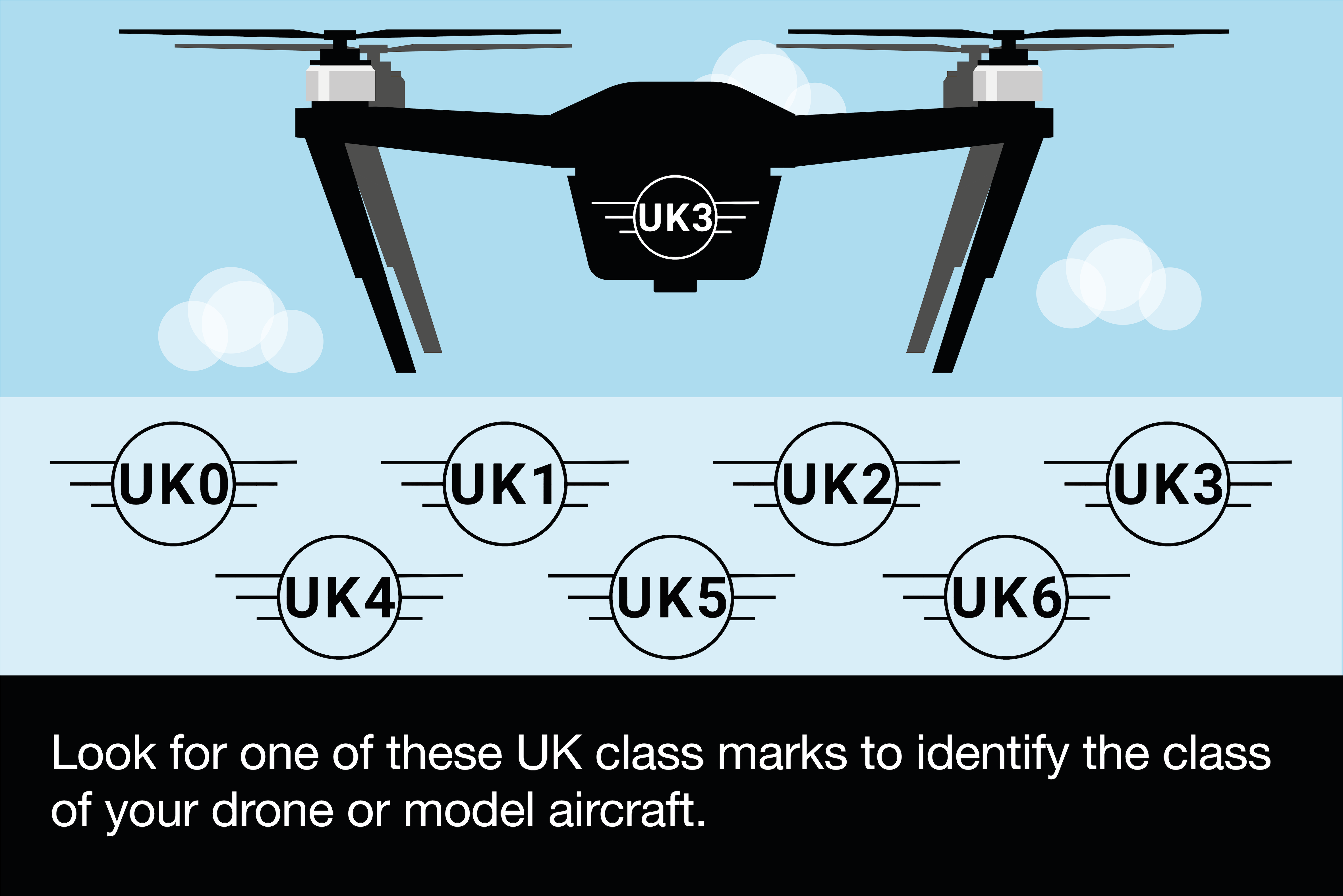
- If your drone or model aircraft has a UK class mark, use the UK column in the class marks table below.
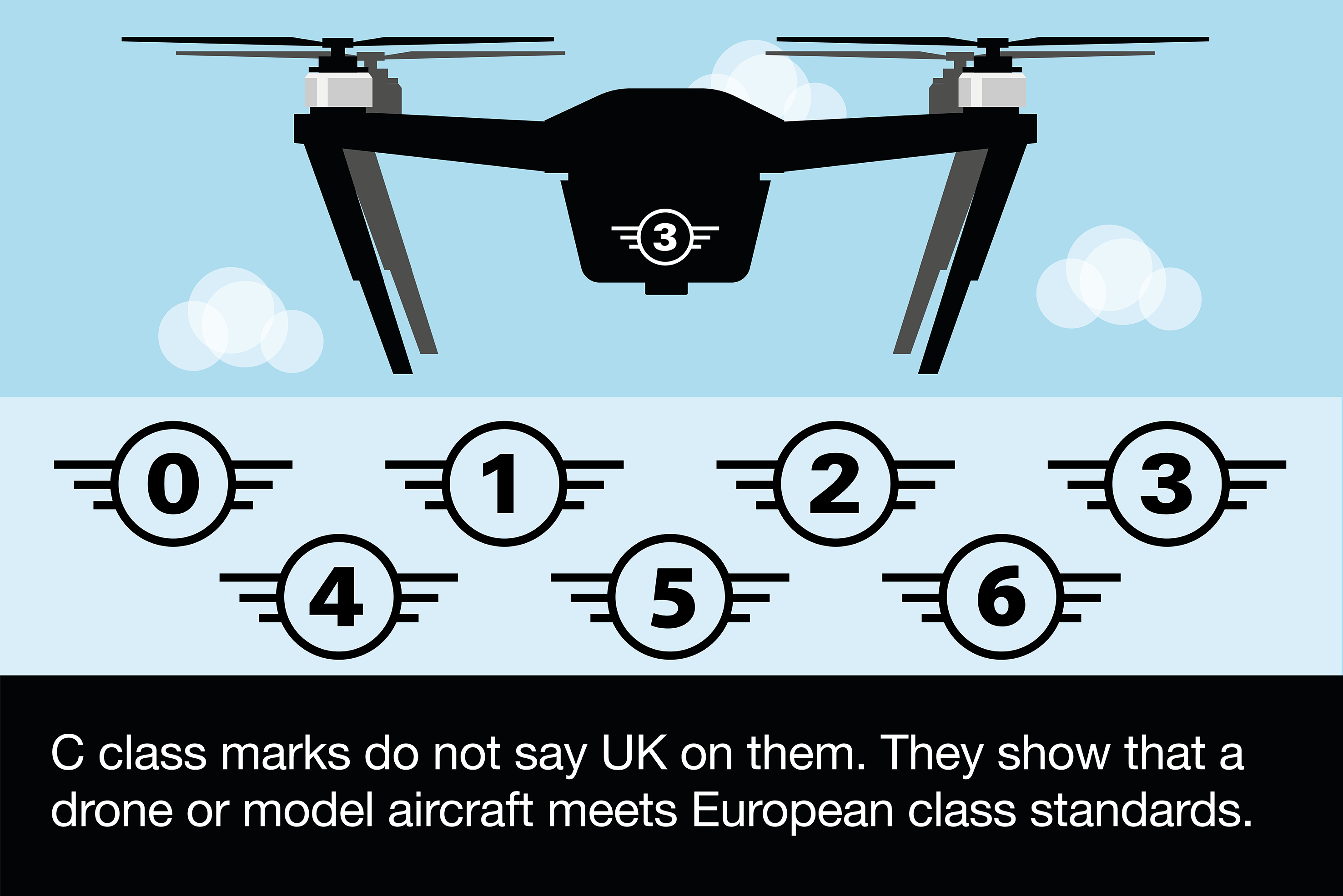
- If your drone or model aircraft has a European class mark, use the European column in the class marks table below.
- If your drone or model aircraft does not have either a UK class mark or a European class mark, use the weight table below.
Class marks and where you can fly
This table shows which Open sub-category you can fly in based on your drone or model aircraft's class mark.
UK class mark |
European C class mark |
Open sub-category you can fly in |
| UK0, UK1 | C0, C1 | Over People (A1) |
| UK2 | C2 |
Near People (A2) if you have an A2 Certificate of Competence Far from People (A3) if you don't have an A2 Certificate of Competence. |
| UK2, UK3, UK4 | C2, C3, C4 | Far from People (A3) |
Weight and where you can fly
This table shows which Open sub-category you can fly in based on the weight of your drone or model aircraft.
Use this table if your drone or model aircraft does not have a UK or European class mark. These aircraft are known as 'legacy' aircraft.
Weight |
Open Category you can fly in |
| Less than 250g | Over People (A1) |
| Less than 2kg | Near People (A2) if you have an A2 Certificate of Competence |
| Less than 25kg | Far from People (A3) |
UK class marks
Any new model of drone or model aircraft placed on the market from 1 January 2026 must have a UK class mark.
The class mark helps you know what Open sub-category you can fly in and whether you need a Flyer ID and Operator ID.
If your drone or model aircraft has a UK class mark, use the UK column in the class marks table to work out where you can fly.
Drones and model aircraft sold or distributed before 1 January 2026
If your drone or model aircraft was made before 1 January 2026, it's unlikely to have a UK class mark. You can still fly it based on its European C class mark or weight.
European C class marks
If your drone or model aircraft has a C class mark on it, the manufacturer has declared that it meets European class standards.
Until 31 December 2027, you can fly a C class aircraft as if it's the corresponding UK class. For example, you can fly a C0 class drone as if it is a UK0 class drone.
If your drone or model aircraft has a European C class mark, use the European column in the class marks table to work out where you can fly.
 Legacy aircraft
Any drone or model aircraft that does not have a UK or European class mark is known as a legacy aircraft.
European C class marks from 1 January 2028
From 1 January 2028, you'll no longer be able to fly a European C class aircraft as if it's the corresponding UK class. It becomes a legacy aircraft and you'll need to fly in the appropriate Open sub-category according to its weight.
Weight
If your drone or model aircraft does not have a UK or European class mark, you'll need to fly in the appropriate Open sub-category according to the weight of your aircraft.
Use the weight table to work out where you can fly.
Flying larger, heavier drones and model aircraft
If you want to fly UK5 or C5, or UK6 or C6 class drone, you must get an Operational Authorisation from the CAA.
What the UK class marks mean
Drones and model aircraft must meet specific requirements before they can be given a UK class mark. The requirements cover factors such as weight, technical functions and safety features.
Overview of the requirements for UK class marks
This section lists the weight requirements to introduce the different classes. Always refer to the regulations for full details.
UK0
Maximum weight: less than 250g, including payload.
Full requirements for UK0 (opens in a new tab).
UK1
Maximum weight: less than 900g, including payload.
Full requirements for UK1 (opens in a new tab).
UK2
Maximum weight: less than 4kg, including payload.
Full requirements for UK2 (opens in a new tab).
UK3
Maximum weight: less than 25kg, including payload.
Maximum dimension: less than 3m.
Full requirements for UK3 (opens in a new tab).
UK4
Maximum weight: less than 25kg, including payload.
Full requirements for UK4 (opens in a new tab).
UK5
Maximum weight: less than 25kg, including payload.
Full requirements for UK5 (opens in a new tab).
UK6
Maximum weight: less than 25kg, including payload.
Maximum dimension: less than 3m.
Full requirements for UK6 (opens in a new tab).
Maintenance and modification to class-marked drones
All drone maintenance should be conducted in line with the manufacturer's recommendations, usually contained within the user manual. If your drone comes with a service contract, you should follow that process in line with the manufacturers recommended schedule.
You may choose to conduct maintenance or modify your drone, if you do this then you must remain within the limitations described within the operational subcategory of your operation. For example, if your maximum take-off mass (MTOM) increases because of modification you may be moved into a different operational subcategory.
You must operate your drone safely at all times.
Retrofitting of class-mark labels
A manufacturer may enable their customers to retrospectively class-mark their drone under the UK class-marking scheme. It is not the role of the CAA to oversee this process and is purely at the discretion of the manufacturer to undertake.